Eamonn Slater, Eoin Flaherty
First published: 17 October 2022
Antipode journal vol. 55, issue 2.
DOI: 10.1111/anti.12886
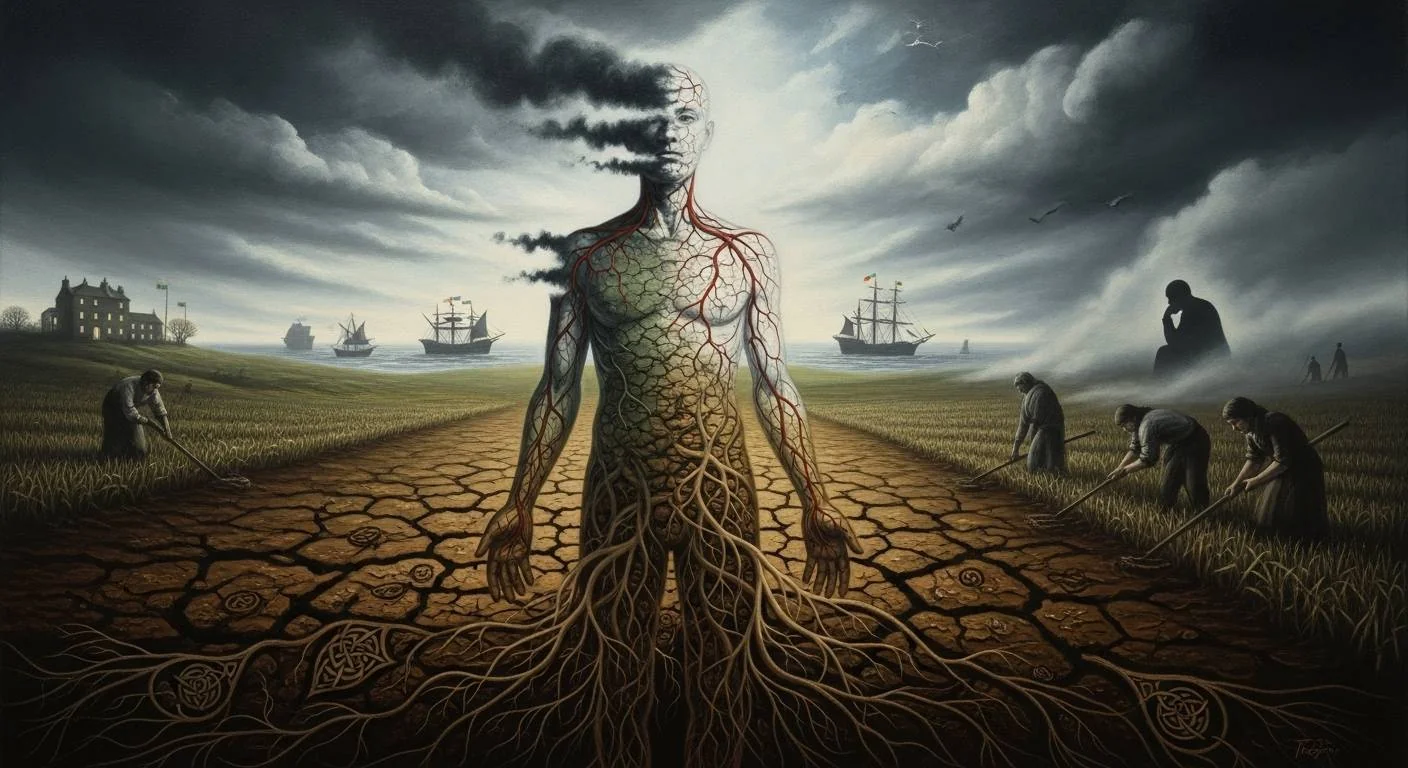
Ireland kept losing people, soil fertility and farm output for decades after the Great Famine ended. In this article, Eamonn Slater and Eoin Flaherty use Marx’s own writings on Ireland to explain why: colonial rule opened two connected “metabolic rifts”, one in the soil and one in the population itself, and together they locked post-Famine Ireland into lasting underdevelopment.
What the article covers
- How Ireland shaped Marx’s ecological thought. The authors work from more than 500 pages of Marx and Engels’ writings on Ireland, including Engels’ unfinished History of Ireland and Marx’s notes for his 1867 speech on the Irish Question.
- The “classic” metabolic rift of the soil. Under the colonial rental system, food grown in Ireland was exported to pay rent, and the nutrients in it never returned to the fields that grew it.
- A new concept: the “corporeal” metabolic rift. Evictions and mass emigration stripped Ireland of its young adults, so the population kept falling even in decades without famine. The article follows Marx’s own census arithmetic, from 8.2 million people in 1841 to 5.8 million in 1861.
- Why evicting the cottier class exhausted the soil. Cottiers did the manuring that kept the fields fertile. After their removal, Marx’s notes record yields falling across oats, flax, turnips and potatoes between 1847 and 1865.
- How the rift reached into family life. Consolidated farms, single-heir inheritance, dowries and delayed marriage pushed the rest of each generation toward celibacy at home or the emigrant ship.
- The economic paradox of post-Famine Ireland. Total farm output fell while rents and landlord incomes rose, which for Marx marked Ireland as a rack-rented feudal economy rather than a capitalist one.
Who will find it useful
- Students writing on the Great Famine, post-Famine demography, or Irish colonial history.
- Researchers in environmental sociology, eco-Marxism and metabolic rift theory who need a fully worked historical case study.
- Historical geographers and scholars of colonialism and underdevelopment.
- Anyone who wants the primary sources gathered in one place: Marx’s 1867 speech notes, passages from Capital and the Grundrisse, and 19th-century agricultural census data.
The article is open access, so the full text is free to read at the publisher’s site.
Cite it as: Slater, E. and Flaherty, E. (2023) “Marx on the Reciprocal Interconnections between the Soil and the Human Body: Ireland and Its Colonialised Metabolic Rifts”, Antipode 55(2). https://doi.org/10.1111/anti.12886
